Abandoned Vehicles, Chicago Towing, and a Complicated History

The situation

Since Jan. 1, 2011, there have been over 250,000 abandoned vehicle service requests to 311, the non-emergency police number in Chicago. Around 200,000 of those are unique requests. Over 10,000 of those requests were made since the start of 2020.

According to the Department of Street and Sanitation, a vehicle is classified as abandoned if it meets one or more conditions of the following criteria:

  1. On a public way in a state of disrepair as to be incapable of being driven in its present condition.
  2. Has not been moved or used for more than seven consecutive days and is apparently deserted.
  3. Has been left on the public way without state registration or a temporary state registration placard for two or more days.
  4. Is a hazardous dilapidated vehicle left in full view of the general public, whether on public or private property.
  5. This does not apply to bicycles.
This Mercedes is one of thousands of abandoned vehicles on Chicago’s streets. Photo: Giovanni Velez

“There’s a seven-day standard but there’s also a standard if it looks like it’s inoperable or hazard or suffering from neglect, they can deem it abandoned,” said Joseph Schwieterman, Director of the Chadwick Institute for Metropolitan Development at DePaul University.

Ruperto Medina, a Chicago Police Officer with 13 years of service, said the vehicles are primarily found in the South and West Sides of Chicago because of so many empty lots there.

“You have abandoned lots [where] a lot of vehicles are [found], especially on the West Side where there’s actual abandoned lots. A lot of people dump their cars there. I say that there are a lot of abandoned vehicles on the South and West Side just because they are abandoned lots to drop these cars off on,” Medina said.

Data from the City of Chicago Data Portal, backs Medina’s estimation, as visualized by this map detailing the 1,000 most recent abandoned vehicle service requests.

In this map, it shows that the concentration of the most recent 1,000 abandoned vehicle service requests congregate more heavily in the West and South Sides compared to other areas of Chicago.

Much like the disparity between locations, the same kind of disproportion exists in the color of the abandoned vehicles.

According to that same dataset, white and black vehicles are the most common with 33,471 and 32,867 respectively. Followed by the color gray rounding out the top three with 22,815.

According to Axlta, which publishes the largest annual Global Popularity Report of its kind in the automotive industry, in 2019 the most popular colors in North America were white (29%), black (19%), and gray (17%). So it makes sense that these vehicles are most likely to be seen in an abandoned state. Simply put, there are more of them on the street.

Here is a pie graph displaying the color distribution of the 10 most common abandoned vehicles in Chicago.

See Interactive Chart here.

THE PERCEPTION

Imagine this: you’ve been walking the same way to work every day, and every day you see the same old dilapidated little car sitting on the side of the road or in someone’s yard. 

You might have some questions about the car, its history, or even why it hasn’t been taken care of yet. What happens to those cars? Whose job is it to take them away? Why is it still here? Does this mean I live in a bad neighborhood?

“Abandoned cars create blight in a neighborhood,” Schwieterman said. “Abandoned cars contribute to perceptions that neighborhoods are suffering from disinvestment and also damage the aesthetic qualities of a street.”

According to an old psychology theory called the Broken Windows Theory, seeing disrepair and disorder could incite further disrepair and disorder. It’s similar to the famous saying “violence begets violence.”

William McCarty, the director of the Center of Research in Criminality, Law, and Justice at the University of Illinois at Chicago, said he doesn’t believe this theory holds much merit.

“I don’t really see a strong support these days for like a broken windows theory, because usually those theories are centered in neighborhoods that already had these very deep problems that are more likely to be causing crime, as opposed to just the abandoned vehicles or the broken windows, so to speak,” McCarty said.

In other words, abandoned vehicles in poorer neighborhoods is a symptom of greater systemic inequality, not the root cause. 

The reality of the location of these vehicles is more likely attributed to the history of Chicago’s tendency to racially segregate and divide communities.

“The poor tend to be concentrated in certain parts of the city. And that likely results in some disadvantaged areas having a much bigger problem with abandoned vehicles than more affluent areas,” Schwieterman said. “And our city is also stratified heavily on racial lines, which certainly aggravates frustration about these kinds of issues.”

See Interactive Chart Here.

The History of Towing and Chicago’s View

Up until 1989, the city of Chicago had its own tow trucks to perform this type of service for the city. This was part of the city-wide move under Richard Daley to privatize city contract work.

However, this is only a part of the problem that Chicagoans have been having with private towing companies. One of the most notorious examples of aggressive and allegedly illegal towing practices is the “Lincoln Towing Service

Photo via Wikimedia Commons

 Their legendarily infamous practices awarded them permanent recognition in a popular folk song: the Lincoln Park Pirates.

According to a 1988 article by the Chicago Tribune, pedestrians were sometimes knifed, beaten with tire irons, and stomped when they refused to let their vehicles be seized.

“I found that interesting to write whenever you introduce the complexity of a private business being involved in sort of a city service, you’ve got different priorities. That private company wants to pick up as many cars as possible, right?,” McCarty said.

However, on the matter of abandoned vehicles, these companies have no say. According to Medina, a police officer is required to fill out a tow slip declaring a vehicle abandoned. 

Additionally, towing companies give some people a second chance. 

“I’ve met a lot of ex gang members that are working for private tow companies that have city contracts. And while it may cost more, because the city’s actually paying someone, it does give the underdog a second chance of making a living for themselves,” Medina said.

__

If you would like to report an abandoned vehicle, call 311 to make an abandoned vehicle service request or fill out this online form.

The service is currently unavailable due to the coronavirus outbreak. It should be available again when the statewide lockdown in Illinois is lifted.

300 Flu Shot Centers Across the Chicagoland Area

Even though Spring is fast approaching and the flu season is coming to end, it is never too late to visit a flu shot center to receive your yearly vaccine.

According to the Chicago Data Portal, here are 300 flu shot centers across the Chicagoland area.

According to the CDC, getting vaccinated yourself can protect others. Including those most vulnerable to serious flu illness like babies, young children, older people, and people with certain chronic health conditions.

Many have asked whether receiving a flu shot will help prevent them from getting the Coronavirus and the answer is no.

However, according to Live Science, even though the flu vaccine won’t prevent you from getting the coronavirus, it can still help officials better respond to the outbreak itself.

The flu vaccine is mainly used to combat influenza and Dr. Albert Ko, a professor and department chair at the Yale School of Public Health believes it’s worthwhile to receive the shot.

“I do think immunizing people against influenza has a very important indirect effect,” he said.

Underperformance Within Chicago’s Public Neighborhood High Schools

By Giovanni Velez & David Astudillo

Chicago Public School’s District Office on Madison Street/ Photo by Giovanni Velez

Mark Villaruel graduated in 2015 from Senn High School, and is one voice within a crowd of Chicago Public Schools graduates who are dissatisfied with the education in their districts’ neighborhood high schools.

“In general, I don’t believe that CPS and their neighborhood high schools are doing enough to prepare their students,” said Villaruel. “Unfortunately, the courses that I was taught at Senn didn’t really translate well when making that transition to college. I think when it comes to success, you need intelligence, talent, and hard work. CPS students need to work that much harder to obtain that success.”

Research shows that one way for students to increase their likelihood of going to college and completing their degree is to take college-level courses in high school.

In CPS, increasing the amount of college courses available early on in high schools is relatively new. Since 2014, the number of students taking courses through the City Colleges of Chicago (CCC) at their high school has tripled, from 1,055 in 2013-2014 to 3,655 in 2017-2018.

This increase has also occurred statewide. Below is a graphic that illustrates the total amount of dual-credit courses in Illinois from 2015 to 2019.

SOURCE OF DATA: ICCB Centralized Data System Annual Data.
Graphic by David Astudillo & Giovanni Velez

VennGage Timeline: Timeline of Dual Credit Enrollment

 However, in CPS, there is a divide between college classes offered at highly-rated schools vs lower-rated ones. According to NPR, data shows that selective enrollment high schools offer more AP classes than neighborhood high schools.

Villaruel said some of the courses he took at Senn didn’t prepare him well enough for college.

 “During my time at Senn, AP courses weren’t offered,” he said. “They were really ambitious when it came to their wall-to-wall IB program. I took three main courses: applied mathematics, IB physics, and IB Spanish. For me, those courses didn’t really translate well when I ended up deciding to go to UIC.”

In 2015, a study even showed that the benefits of taking a college level course are diminished for students of color and those with lower income background.

Neighborhood High Schools Underperform in Key Metrics

Historically, neighborhood high schools tend to underperform in key metrics such as attendance, freshman on track, college enrollment, and graduation rates.

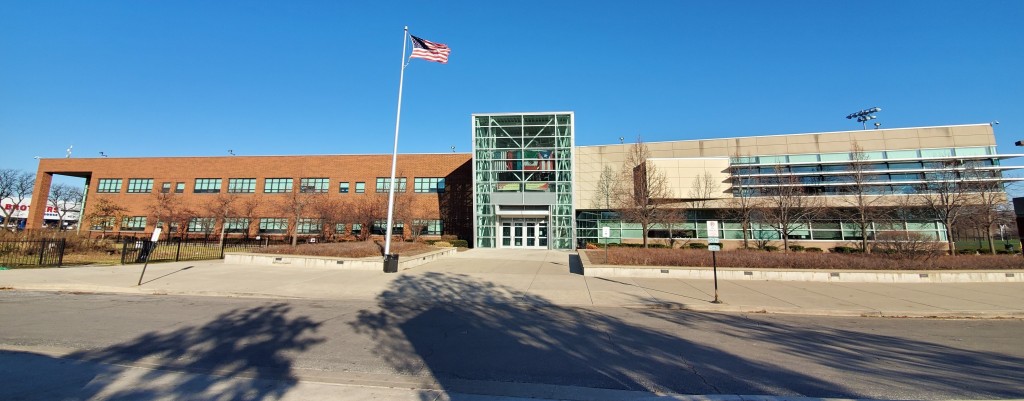
In the past couple of years North Grand High School, a neighborhood school on the west-side of Chicago, has been improving these key metrics. Below are some of the programs and initiatives that have been implemented over the years:

The front of North Grand High School/Photo by Giovanni Velez & David Astudillo

Attendance 

According to Emily Feltes, who became the principal of North Grand High School in 2016, the school was in the mid- to high-80s in terms of overall attendance rate eight years ago.

Recently, North Grand had their highest attendance rate in a really long time–hovering just under 91%. According to Chicago Data Portal, the average attendance rate for neighborhood high schools in 2018 was 86%. CPS in its entirety had an average attendance rate of 93%. 

Feltes said that she works with her attendance coordinators on a daily basis to support her students.

 “Some kids who go to [a] neighborhood school, just getting to school is difficult, and that could be for a variety of reasons,” she said. “They might live far away; they may have family obligations… They may be working late. So, in order to help students with attendance, what we did here at North Grand is create an attendance office.”

She continued: “Something I do as a principal is literally every day I check in with our attendance coordinators. I see how many students are absent and which students are absent. [Essentially] we’re looking for trends and patterns…[and] we try to find the root cause of why the child is not making it to school.”

Freshmen on Track

Studies show that if students are passing core classes freshman year, that puts them in a strong position to graduate on time.

Eight years ago, North Grand had a 76 percent freshmen on track rate. Since then, the school has consistently been at 90 percent or higher. At the 10-week mark, 97 percent of freshmen are on track.

What makes North Grand unique in this situation is that all freshmen are required to take a class called freshman seminar.

Lisa Courtney, a teacher who has been teaching at North Grand High School since 2007, is one of the main instructors for freshman seminar.

 “Freshman seminar is a support class, but it’s also [a] credit bearing class and students get a grade for it… they have it every day. So as opposed to other schools who have similar structures, but it might be an advisory, or like once a week…” she said.

Courtney explained the structure of the class and why it’s beneficial for students in their first year transitioning to high school.

  “We do a lot of identity work [and] social emotional work that first quarter. [In the] second quarter we move into [a] mental health project that’s part of their service learning requirement. [In the] third quarter we do college exploration…[and in the] fourth quarter we do job hunting, like basic resume interviewing skills.” she said.

Here is a complied list of 39 neighborhood high schools and their key metrics compared to overall CPS averages. All of the data comes from CPS school locator and Chicago Data Portal.

The Overall Decline in CPS Enrollment

According to a recent ABC 7 Chicago story published on Nov 8, 2019, the total amount of students enrolled in CPS has declined for the 8th year in a row. CPS announced that a total of 355,165 students were reported for the 2019-2020 school year across 642 schools. That’s down from the 2018-2019 school year when enrollment was at 361,314 students. Officials do say that the significance of this decline has decreased when compared to the previous three years.

Flourish Graph: Annual Student Enrollment in Chicago Public Schools

However, the decline is even more staggering when it comes to CPS neighborhood high schools. According to a news story published back in 2017 on DNAinfo, data indicates that neighborhood high schools in Chicago are essentially on life-support.

As of 2017, less than 25 percent of students actually attended their designated neighborhood high school. Twelve years ago, nearly 45 percent of students went to their neighborhood high schools.

Feltes believes that there are multiple factors at play when it comes to the decline in CPS enrollment.

“The answer is nuanced…some families are perhaps moving out of the city, like looking for more affordable housing…We have a great, beautiful, wonderful city. But sometimes it’s difficult for families, [there are certainly] social and economic factors that influence attendance in public schools” she said.

Feltes added, “School choice is this idea that kids can have an option or a choice, they don’t just have to go to their neighborhood school. If they don’t get into a selective enrollment school, they might be able to go to another school and that’s something that GoCPS has expanded.”

Looking Forward into the Future of CPS

Both Feltes and Courtney said they believe that CPS has lots of room for improvement when it comes to providing an education that is equitable for all of its students.

 “I think a big issue is equity…CPS can probably do a better job ensuring that the wealth is spread around.”

Providing an education that contains both value and fairness to all is key to improving CPS and its neighborhood high schools. Principal Feltes believes that CPS is heading in the right direction.

“There are many other neighborhood schools and other CPS high schools that offer great programs that are going to prepare kids to be successful. So, I think as a district, we’re working on making all of our schools better. So that no matter where you’re from, and no matter what high school you go to, you’re able to have that type of high-quality experience” she said.

10 Notable Pumpkin Patches Across the State Of Illinois

A field of Pumpkins (Photo by Creative Commons)

The fall season has finally arrived and with its arrival comes a new opportunity to take your family and create new long-lasting memories. Whether it’s a haunted hayride, riding in a cow train, or even using an awesome corn cannon, Illinois has a great variety of pumpkin patches with their own little twist.

For that reason, here is a list of 10 great pumpkin patches in Illinois. With each having their own little description of what makes them unique, their address, phone number, website, video, and rating via Google’s star rating system. All prices vary so check out their respective websites for more information.

When its all said and done and these options don’t fulfill your needs for your family, do not worry. Click here for a more comprehensive list with different options.

Design a site like this with WordPress.com
Get started